Showing posts with label DIY. Show all posts

Jun 30, 2012

Make Your Own Stencil For Fabric Painting - Condor Shirt


How are you all dealing with the heat and humidity?  Today I distracted myself with a new creative project.

I am really drawn to condors and I decided to try making a stencil that I could use for putting a condor silhouette onto a Tshirt.  I know that some people use freezer paper for this.  I didn't have any and I also wanted the stencil to last through many uses so I decided to use poster board.  You could also use bristol board or thick card stock.  This is the first time I've used Tulip fabric spray paint and it was much thinner than I expected.  I don't know if the poster board will last through the first use without warping so I plan to put a coat of acrylic paint on both sides first.

I found a condor silhouette that I liked using Google Image search.  Then I edited it in Paint to remove most of the black (saves printer ink).

Here are photos and notes of the process.  If you can't read the text, please click on the image to make it larger - the blurriness goes away.
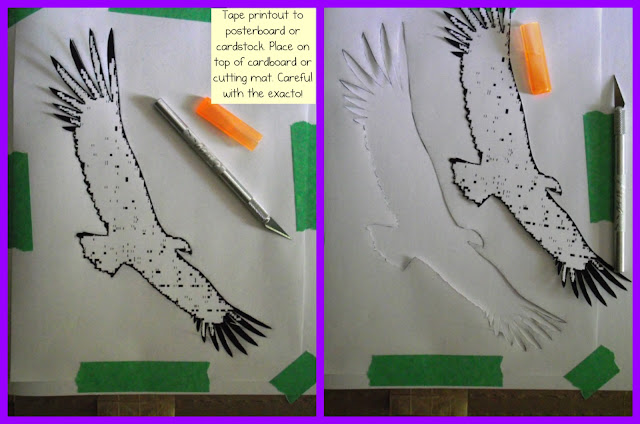


I'm really happy with the results!  :-)

Photo collages and effects created using the free program http://fotoflexer.com

Mar 26, 2012

Arashi Shibori Style Tshirt Alteration

Something I've been loving recently is using a silk dying technique called Shibori.

I use very watered down acrylic paints as a fabric paint rather than fabric dyes and I'm using non-silk fabric so what I'm doing isn't actually Shibori - but that is what has inspired and informed me.

The particular Shibori technique I've been using is called Arashi aka Pole Wrapping. Usually it's done on a diagonal but with this Tshirt, I've done it vertically. I wasn't too careful about making the top of the paint be in an evenly horizontal line which is driving me a bit nuts but I don't notice it much when I wear it so hopefully I will be able to ignore it :)

For those interested in trying this, I didn't even buy any special supplies (eg PVC pipe, sinew or waxed twine).

I covered an old cardboard tube with a plastic bag (so it wouldn't get soggy when it got wet) and used a rubber band to hold each end of the shirt on and used waxed dental floss to wind around. I'm sure twine would be easier on the hands (dental floss is so thin and my fingers were pretty sore afterward) but I like using what I have on hand. When I'm done, I unwrap the floss and wind it onto an old cardboard toilet paper roll to re-use for future Shibori :)

Because the paint was applied by hand to a mostly dry Tshirt, most of the colour stayed on the top exposed layer of the shirt. When using a dye bath or having the shirt very wet first, more of the colour will spread through other layers.

I washed and dried once before wearing. I've had great success using inexpensive acrylic 'craft' paint instead of fabric paint. It does need to be watered down to avoid being stiff or crunchy. I've never used any of the additives you can buy to 'transform' acrylic paint into fabric paint.

This was a plain orange Tshirt and I was hoping for a flame-like effect along the bottom of the shirt:

Check out this great post showing various Shibori techniques: DIY Shibori

Aug 2, 2011

Feather Eraser Stamp (hand-carved)

All wrapped up and ready to send to a lovely woman who inspires me
(I forgot to take a photo of the stamp itself before wrapping it up... oops! :-)

Have you tried carving your own stamps from erasers yet?
It's so much fun! I love using them in art journals, on cards, envelopes, and other paper crafts.
T
hey also make wonderful, personal gifts.
Vinyl erasers work best and if you think you'll do this more than a few times, it's totally worth the money to buy a linoleum cutter (also called Lino cutter). I have the Speedball one shown in this photo.


It has a number of different tips to choose from and I find it very handy how they can all be stored in the handle. No chance of losing them. You can carve stamps using utility/exacto knives but a cutter like this is much safer and sooo much easier.
After only a few stamps, it will have paid for itself. I tried a few different kinds of vinyl erasers before settling on one I liked. This one cuts like butter. So smooth. And it's not scented - unlike most that I tried. Ick.

There are many tutorials online. Here are a few(note that you can also use carving blocks sold at art or printing stores. It's nice to begin with erasers because they are so cheap you may be less held back by fear of messing up!):
I saw this video of Geninne's only after I carved my feather stamp. Hers is amazing! (of course :)
Geninne in action

non-video tutorial part 1
non-video tutorial part 2

I confess that I don't have the patience to draw the design first and transfer it onto the eraser as shown in those tutorials. I draw directly on the stamp or just freehand it without drawing at all.

*Tips*

1. If you wear a cotton glove on the hand holding the stamp, you're less likely to get cut if you slip. This may seem unnecessary but it's totally worth it in my opinion :) Those blades are supr sharp.
2. If you will be carving curved lines, it's much easier to have the eraser on a small piece of paper that can slide around easily - then you can twist/turn the eraser itself as you go around corners rather than trying to move the cutter in a smooth, curved line.
3. Start gently. You can always cut deeper later but you can't add back parts you've removed!
4. When you are first getting the hang of this art, you can use all sides of the eraser to practice on. It will save money and be kinder to the environment.
5. If you create any kind of mixed media art, you can also save the shavings you carve off the eraser, mix them with glue or gel medium, and create very funky background textures for paintings etc.


Have fun!

Jul 28, 2011

Flower Within Mandala


I love this mandala - both the regular and the inverted versions make me smile :-)

created using sumopaint.com
source image (an envelope I decorated by hand):

Feb 20, 2011

Super Simply Sewn Satiny Scarf forThree Dollars

I adore all things shimmery, satiny, sparkly and metallic. I also love flowing clothing that moves when I do. At the same time, I'm a bit of a tomboy - the type who likes climbing trees, can't wear white without getting it dirty, washes all colours together in the laundry, and has zero tolerance for clothing that is uncomfortable. Fragile clothing, worn by me, invariably gets damaged. I choose jewelry based on how unlikely it is to get caught on things or banged up in the garden :-) When I see women with rings that stick up, I instantly think, "How do they handle that? It would bang into everything!"

I've been eying the many styles of scarves in stores lately and most of them are either made from material that feels scratchy or are so fragile they would fall apart in the wash (I also have low tolerance for clothing that can't just be tossed in the washer with everything else :).
The scarves out now are also pricey! It feels wrong to me to spend $15-20 on a tiny piece of fabric that would cost about $1 to buy.

So I decided to buy fabric and try making my own! My sewing skills are basic and I don't have patience with patterns and pinning so my creations sometimes work... and sometimes don't.

Thankfully this experiment went pretty well.

This lovely fabric shimmers in the sun and has a beautiful, satiny feel to it... yet it's made from polyester and can be tossed in the washer and dryer - yay!

widthwise seam, inside

I didn't take a photo of the first step which was to cut half a meter of fabric in half, lengthwise and sew two ends together widthwise. You can see those ends sewn together vertically in the photo above.

lengthwise seam inside

Then I had one long, narrow piece of fabric about 10 inches wide. I folded it in half with the right sides together and sewed the 2 'wrong' sides together. I didn't bother pinning, just matched up the sides as I went along with a simple straight stitch. The fabric was not cut evenly at the store so it's not even but it doesn't show when it's being worn.

widthwise seam, rightside out

That photo above is how the outside seam looks where the 2 long pieces were joined widthwise.

lengthwise seam rightside out, unironed

When I was done sewing lengthwise, I had a long tube with both ends open. At that point, if you wanted closed ends, you would sew one end closed all the way and the other end closed except for a few inches (then pull the tube rightside out through the small opening and handsew it closed). I wanted my ends left open so at this point I simply turned the long tube rightside out... and I was done! I could have ironed it so that it will lay flat but I really like the body and fullness it has and I don't want to flatten it one bit :-)

big, long tube scarf, outside


The ends didn't match up perfectly and I'm not sure what I'm going to do about that yet. I'm pretty laid back so I may just leave it :)


Total cost for this project:
only
$3
(for the fabric)


*I've never tried to describe a sewing project in text before so if you have any questions or would like me to clarify something, please do not hesitate to let me know in the comments :)

Related Posts Plugin for WordPress, Blogger...

Followers